ADHD

Systemic Abuse as Structure: How Industrial Systems Harm Divergent Lives

© Alexandra Chambers | Neurotopia CIC | February 2026 It is no longer credible to frame the repeated failures of public systems toward divergent populations as accidental. These are not isolated oversights or unfortunate gaps in provision. They are embedded patterns – recurrent, predictable, and institutionalised. Across healthcare, education, housing, social care, and public health […]

Systemic Abuse as Structure: How Industrial Systems Harm Divergent Lives Read More »
Pathologising Divergence: How the System Teaches Evolved Minds to Erase Themselves

© Alexandra Chambers | Neurotopia CIC | February 2026 There is a quiet war taking place – not fought with weapons, but with language, systems, and selective definitions of “normal.” It is a war against difference, against depth, against adaptation. At its heart lies a subtle but brutal inversion: those who are most sensitive, most

Pathologising Divergence: How the System Teaches Evolved Minds to Erase Themselves Read More »

Part 2: Intelligence, Architecture, and the Legacy of Divergence

© Alexandra Chambers | Neurotopia CIC | February 2026 For much of modern history, the figure of the Neanderthal has functioned as a symbol of what we imagine ourselves to have transcended from. Popularised reconstructions depicted a lumbering brute, heavy-browed and vacant-eyed, only partially human. This imagery served more than aesthetic purposes; it reinforced a

Part 2: Intelligence, Architecture, and the Legacy of Divergence Read More »

Part 1: Hybrid Minds: Rethinking Neurodivergence Through the Lens of Interspecies Inheritance

© Alexandra Chambers | Neurtopia CIC | February 2026 For decades, neurodivergents have been pathologised without context – framed as disordered, deficient, or inherently dysfunctional. Yet emerging genetic evidence demands a radical reframe: what if these so-called disorders are inherited expressions of an ancient hybrid lineage? Modern Homo sapiens are not a pure species. Around

Part 1: Hybrid Minds: Rethinking Neurodivergence Through the Lens of Interspecies Inheritance Read More »

Divergent Pregnancy and Uterine Anomaly: Failure of Standard Maternity Care

© Alexandra Chambers | Neurotopia CIC | January 2026 During my first pregnancy, the foetus remained in breech position throughout. As I approached term, NHS clinicians became increasingly insistent on scheduling an external cephalic version (ECV) – a manual procedure to turn the baby into a head-down position. I declined because I had a deep,

Divergent Pregnancy and Uterine Anomaly: Failure of Standard Maternity Care Read More »

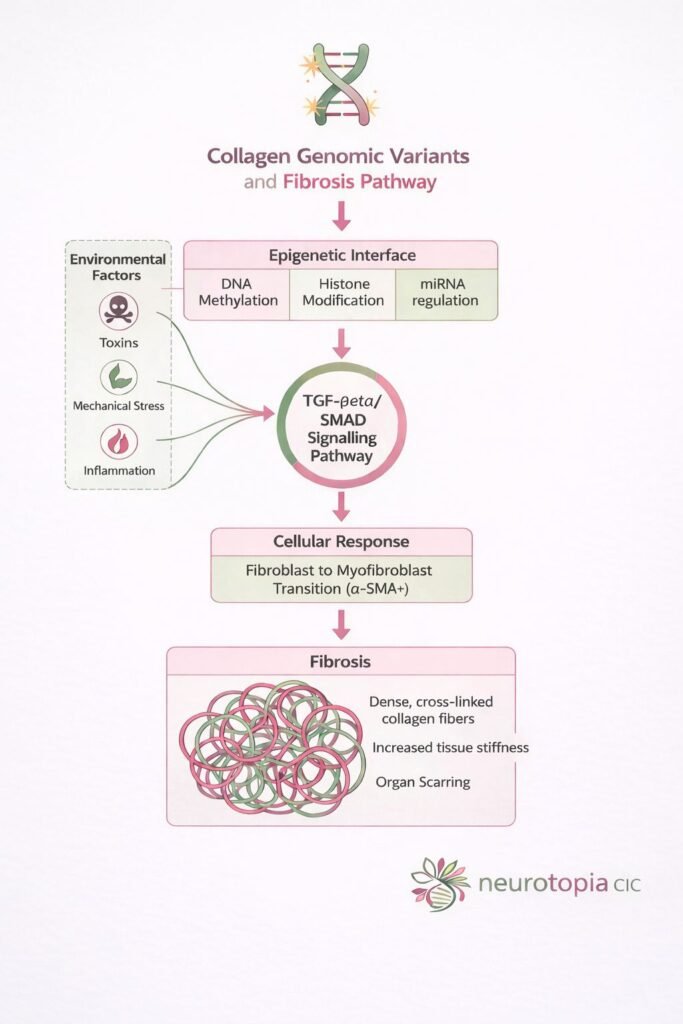
What is the SMAD Signalling Pathway – and why is it Important for Divergent Bodies?

© Alexandra Chambers | Neurotopia CIC | January 2026 In connective tissue divergence, immune sensitivity, or genomically divergent bodies, fibrosis is one of the most damaging long-term outcomes. Here I will explain what actually drives that scarring process deep in the tissues. At the heart of the fibrosis response is a powerful molecular communication route

What is the SMAD Signalling Pathway – and why is it Important for Divergent Bodies? Read More »

My Perspective on the now, Solutions and Change

© Alexandra Chambers | Neurotopia CIC | January 2026 For systems and for the people inside them, real change starts with recognising reality in its entirety. That is a timely and uncomfortable process; it asks people to sit with things that don’t have immediate answers. To see the scale of what’s wrong, without rushing to

My Perspective on the now, Solutions and Change Read More »

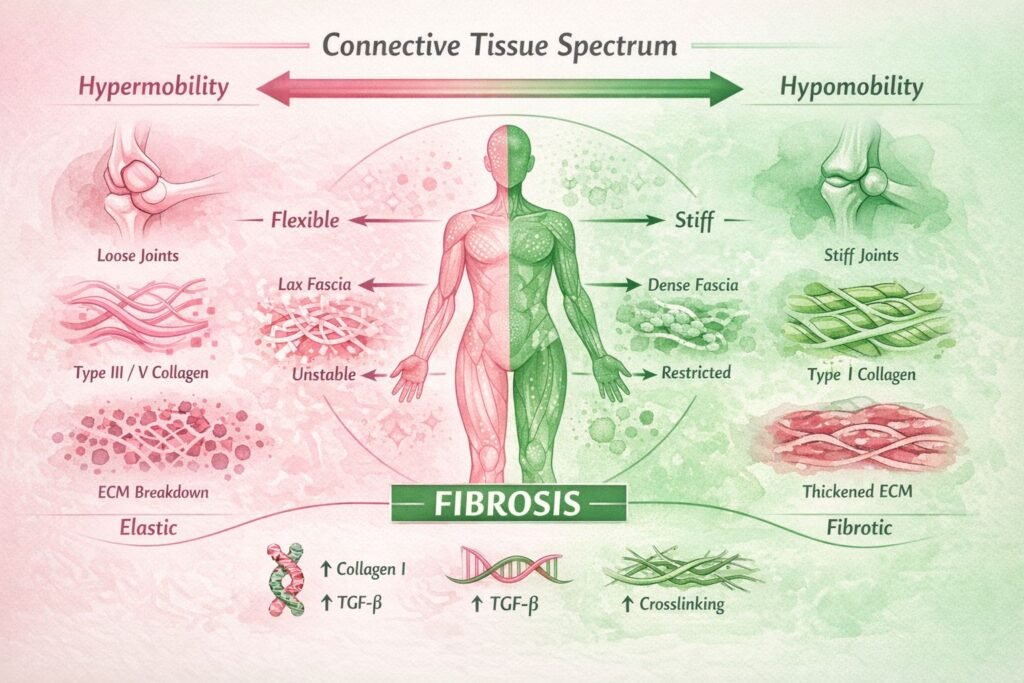
The Spectrum of Mobility: Can a Person be Both Hypermobile and Hypomobile?

© Alexandra Chambers | Neurotopia CIC | January 2026 While mainstream narratives often frame connective tissue profiles in binary terms – either hypermobile or (rarely) hypomobile – the lived reality is often far more complex. In truth, it is biologically and mechanistically possible for different parts of the same body to express divergent mobility traits.

The Spectrum of Mobility: Can a Person be Both Hypermobile and Hypomobile? Read More »

Rewriting the Rules: Visual Directionality, Divergent Brains, and the Hidden Architecture of Reading

© Alexandra Chambers | Neurotopia CIC | January 2026 Most modern reading systems are designed around a narrow set of neuro-visual and anatomical assumptions. They presume a brain that is left-hemisphere dominant for language, a visual system that comfortably tracks from left to right, and a body whose fine motor control aligns with right-handed writing.

Rewriting the Rules: Visual Directionality, Divergent Brains, and the Hidden Architecture of Reading Read More »

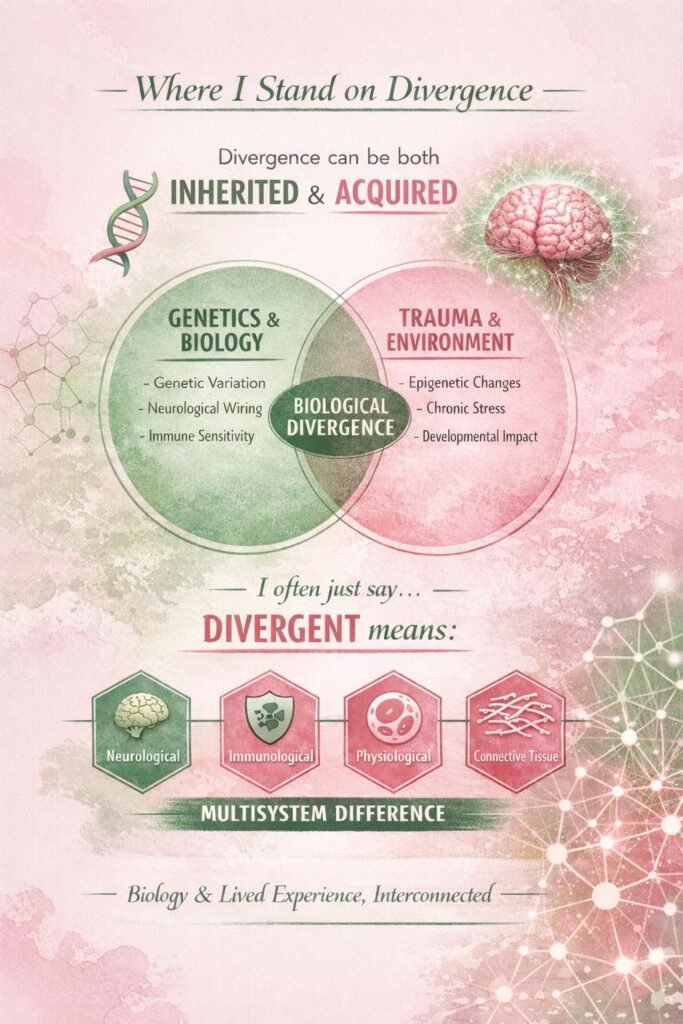
My Perspective on Neurodivergence: Inherited and Acquired, Biological and Political

© Alexandra Chambers | Neurotopia CIC | January 2026 I want to take a moment to be clear about where I stand when it comes to neurodivergence – especially in relation to inherited vs acquired forms, and how I understand their biological and social dimensions. Neurodivergence is Real – Even When it’s not Diagnosed The

My Perspective on Neurodivergence: Inherited and Acquired, Biological and Political Read More »