© Alexandra Chambers | Neurotopia CIC | January 2026
Mainstream science has just “discovered” what many of us have known for years: that endometriosis is connected to more than the reproductive system.
New research from Penn State finds that people with endometriosis have blunted blood pressure responses to physical stress – contradicting their initial hypothesis that chronic inflammation would lead to heightened cardiovascular reactivity. The researchers call this surprising. For those who understand the wider terrain – it’s not surprising at all. What’s surprising is that the system still doesn’t get it.
Because once again, they’ve got the direction of causality backwards.
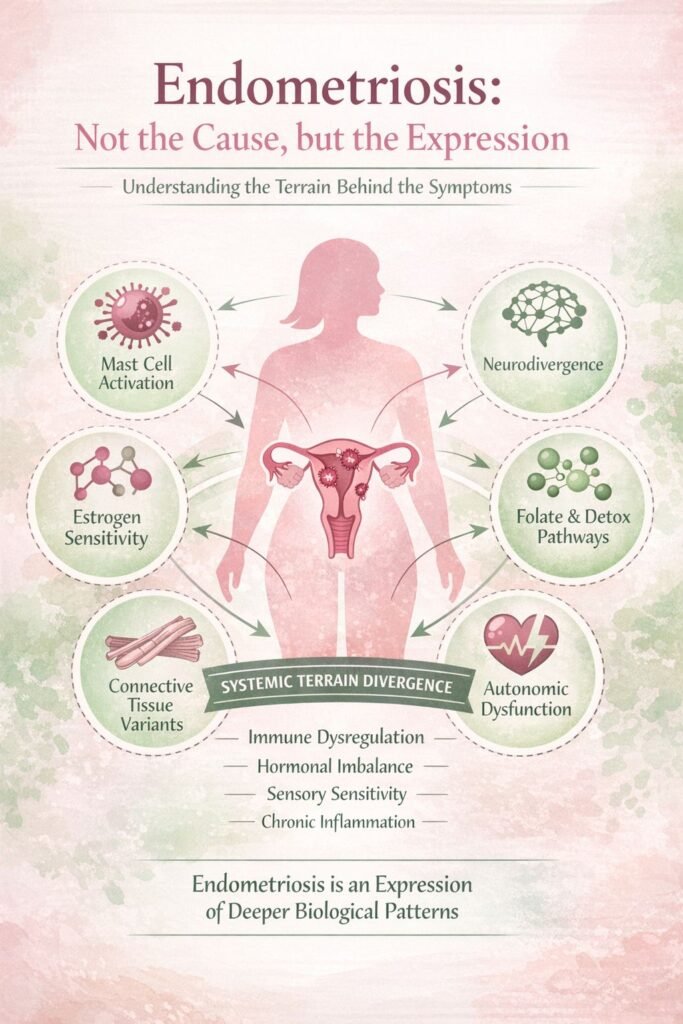
The Core Inversion: Endometriosis Isn’t Causing Systemic Issues – the Systemic Terrain is a Susceptibility to Endometriosis
In the dominant model, endometriosis is framed as a localised disease with downstream effects. This is reductionism at its most damaging – isolating a visible symptom and treating it as the root. However, what’s actually happening is far more complex, and far more systemic.
Endometriosis is not the cause of multi-system dysfunction…It’s a manifestation of multi-system divergence that has succumbed to dysfunction, likely due, or related to being unacknowledged in current systems and understanding.
The immune system, the fascia, the hormone receptors, the autonomic wiring – all of these interact to create the conditions where endometriosis can take hold. These systemic patterns don’t start with the uterus; they start with the terrain.
Mast cell activation.
Estrogen hypersensitivity.
Altered glycogen processing and storage.
Connective tissue variants.
Folate cycle disruption.
Neuroimmune cross-talk.
Impaired detoxification.
Altered microbiota.
Neurodivergent sensory profiles.
These don’t result from endometriosis – they precede and amplify it.
The medical model still treats the lesions as the problem, when they’re actually a signal. A symptom of a much deeper mismatch between body systems and environment.
 A Divergent Terrain
Endometriosis is disproportionately present in neurodivergent populations.
Autistic and ADHD individuals are more likely to have connective tissue differences (e.g., hypermobility syndromes).
They are more likely to have dysautonomia, POTS, MCAS, chronic pain, and complex inflammatory reactions.
Sensory hyper/ hypo sensitivity – including pain amplification – is intrinsic to many neurodivergent profiles.
Genetic variants in estrogen metabolism, folate processing (e.g., MTHFR), and detox pathways are often shared.
So when mainstream researchers find altered blood pressure stress responses in people with endo, they interpret it as a novel discovery. In truth, they’re observing the downstream physiology of a divergent system – one that doesn’t behave by “normal” rules because it was never designed to.
Why do They Keep Getting It Wrong?
This isn’t just a case of bad hypotheses. It’s a structural blindness:
Medical research isolates symptoms.
It doesn’t know how to think in networks, systems, or terrain.
Women/girls are under-researched.
Especially when they present with overlapping, non-linear, or “invisible” symptoms.
Neurodivergent physiology is systematically misinterpreted.
Pain thresholds, immune responses, hormonal rhythms, and nervous system activity diverge from standard models.
So what happens? We get told the pain isn’t real. The symptoms are “unrelated.” The stress response is “blunted” -.as if that itself isn’t a clue.
 Changing the Question
Instead of asking, “What does endometriosis cause?”
We need to be asking:
“What shared terrain makes endometriosis more likely to emerge?”
That question opens the door to real answers:
The link between endo, hormone signalling and connective tissue genes (e.g., COL5A1, COL3A1)
The role of folate cycle overload and synthetic supplementation in estrogenic tissues.
How divergence in sensory processing amplifies chronic pain and dysautonomia.
Why mast cells, fibroblasts, and immune cells behave differently in neurodivergent bodies.
How these differences evolve across the lifespan – from menarche to menopause
This is not fringe theory; this is systems biology – and it’s long overdue.
Reframing the Narrative
The new endometriosis research doesn’t just reveal a novel stress response. It reveals, once again, the limits of a reductionist model that cannot see the whole.
Endometriosis is not “just” a reproductive disorder.
It’s a lens – a highly visible expression of terrain divergence.
Until we stop isolating symptoms and start mapping systems, the people most affected – divergent, multiply-marginalised, late-diagnosed people – will continue to be misdiagnosed, mistreated, and misunderstood.
Endo isn’t the beginning of the problem – it’s a signal of something deeper.
 –
– Link to Scientific Article: